
How to Load Out STOIRM EDC Pouches
How to Load Out STOIRM EDC Pouches
A good pack is only as effective as the way it is organised.
Loose kit slows you down. Cables tangle. First aid gets buried. Navigation equipment moves around. Small tools disappear into the base of the bag.
STOIRM EDC pouches are designed to solve that problem. They let you build task-specific loadouts that can be attached, removed and reconfigured across the STOIRM pack system. One pouch can be built for first aid. Another for IT. Another for navigation. Another for tactical accessories. When the task changes, the pouch changes with it.
Why Modular Pouches Matter
The STOIRM Eco-System is built around modular organisation. Instead of treating a pack as one large empty space, pouches let you break the load into defined zones.
That means faster access, better control and less wasted movement.
A pouch can hold a specific category of kit, then move between the STOIRM 25L Tactical Pack Gen2, 40L Tactical Pack Gen2, Messenger Bag, Tote Bag or 50L Duffel. This gives you a repeatable system. Build the pouch once. Place it where the task demands.
For daily carry, that might mean a small pouch for cables and charging equipment. For field work, it might mean a navigation pouch, a first aid pouch and a utility pouch. For travel, it might mean separating admin, tech, clothing and wet weather protection.
The STOIRM Pouch System
The current STOIRM pouch range includes Small and Large Mesh Pouches, Small and Large Pouch V.1, Small and Large Pouch V.2, the Utilities Pouch, MOLLE Panels and the Travel Cube with Laundry Bag.
The Mesh Pouches use a visible mesh design, smart hook-and-loop backing, internal elasticated stitched bands and Hypalon front tabs. They are built for quick identification and access.
The V.1 Pouches use internal pockets and elastic strap holders to keep equipment secure. They include a laser-cut MOLLE panel with Hypalon strap, waterproof zipper, Hypalon strap handle and hook-and-loop ID panel.
The V.2 Pouches build on that layout with a split carry system and a dayglow orange zipped gear dump pocket. This makes them useful when you need a pouch that can hold organised items and also take loose kit quickly.
The Utilities Pouch is a compact, versatile option for smaller accessories and gear. It uses a hook-and-loop base so it can be positioned within STOIRM packs.
The MOLLE Panels allow pouches to be attached and configured inside the pack using the STOIRM hook-and-loop interior. They help turn an open pack into a structured load carriage system.
Tactical Loadout
A tactical pouch should be built around fast access, clear separation and secure retention.
Use a Small or Large Pouch V.1 when you need elastic retention for compact tools, lighting, gloves, notebook, markers, batteries, identification items or small accessories. The internal elastic strap holders help stop items shifting inside the pouch.
Use a V.2 pouch when the loadout needs both structure and a dump pocket. The dayglow zipped pocket gives a defined space for loose items that still need to be contained.
For tactical use, avoid overloading one pouch. A pouch should have a job. If it becomes a general dumping ground, it slows the system down.
Suggested setup:
Tactical admin pouch: notebook, pen, ID items, compact torch, spare batteries, tape, markers.
Utility pouch: gloves, small tools, cable ties, cleaning cloth, compact accessories.
Task pouch: role-specific items required for the operation.
The aim is not to carry more. The aim is to carry better.
Navigation Equipment Loadout
Navigation equipment needs protection, visibility and a consistent place in the pack.
A Large Mesh Pouch works well for items that need to be identified quickly. Mesh allows you to see the contents before opening the pouch. This is useful for maps, compass, GPS accessories, waterproof notebook, pencils, batteries and signal items.
A Small Pouch V.1 or V.2 can be used for compact navigation tools that need stronger containment. The elastic organisers help keep smaller items in place.
Suggested setup:
Navigation pouch: compass, GPS accessory cable, map tools, waterproof notebook, pencil, headtorch, spare batteries.
Keep the pouch near the top of the pack or attached to an internal MOLLE panel where it can be reached without disturbing the full load.

First Aid Loadout
First aid should never be buried.
A first aid pouch needs to be easy to identify, easy to remove and placed in a consistent position. The STOIRM pouch system allows a dedicated first aid pouch to be moved between packs depending on the task.
A Large Mesh Pouch gives quick visual confirmation of contents. A Large Pouch V.2 gives more structure and adds a separate dayglow zipped pocket for smaller items.
Suggested setup:
First aid pouch: dressings, gloves, wipes, tape, blister care, compact shears, personal medication where required.
Do not mix first aid with general utility items. A first aid pouch should stay clean, dedicated and easy to locate.
Cables and Charging Loadout
Cables are small, flexible and easy to lose. They need containment.
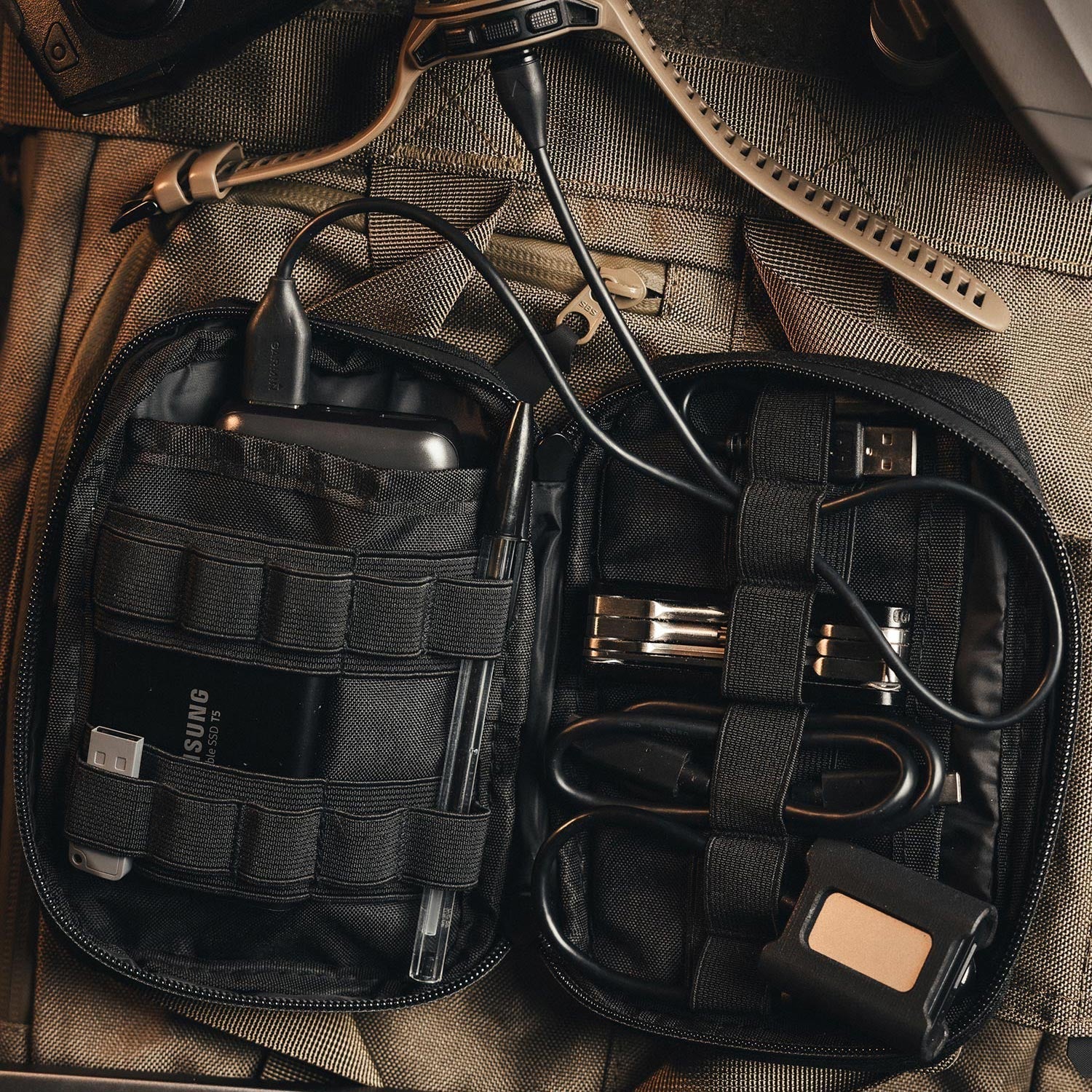
A Small Mesh Pouch works well for everyday charging leads, adapters and compact power accessories. The mesh construction makes it easy to identify the contents, while the internal elasticated bands help keep small items controlled.
A Small Pouch V.1 works better when the contents need more protection or stronger separation.
Suggested setup:
Cable pouch: USB cables, charging plug, power bank, memory card case, adapter, earphones, cable ties.
For travel or work use, build one cable pouch that stays packed. Move it between the 25L Pack, Messenger Bag, Tote Bag or Duffel depending on the day.

IT Equipment Loadout
IT equipment needs more structure than general EDC.
The STOIRM 25L and 40L Tactical Packs include a padded 17-inch laptop compartment. The Messenger Bag and Tote Bag also support organised tech carry with laptop storage and internal organisation features. Use the main laptop compartment for larger devices, then use pouches to manage smaller equipment.
Suggested setup:
IT pouch: mouse, charger, adapters, SSD, USB drives, card reader, cleaning cloth, cable set.
A Large Pouch V.1 or V.2 is well suited to IT accessories because the elastic retention helps reduce movement. A Mesh Pouch is useful when you need quick visual access to cables and small tech items.
Do not place heavy tech accessories loosely in the main compartment. Use the pouch system to stop impact, movement and cable damage.
Reconnaissance and Observation Loadout
Reconnaissance and observation tasks rely on access to small, important items. The loadout should support quiet organisation and quick identification.
Use a Large Pouch V.2 for mixed equipment where some items need fixed retention and others need a dump pocket. Use a Mesh Pouch for items that benefit from visual identification.
Suggested setup:
Reconnaissance pouch: compact notebook, pen, map tools, small torch, batteries, lens cloth, compact optic accessories, markers.
For photography, survey or field observation, a dedicated pouch can hold camera batteries, memory cards, cleaning kit and small accessories. This keeps the pack clean and reduces the risk of losing small components in the main compartment.
Weapons Equipment Loadout
For professional users handling weapon-related accessories, organisation and separation are critical.
A dedicated pouch should be used only for the relevant equipment. Keep it clearly identified and separate from medical, navigation and admin kit. The STOIRM V.1 and V.2 pouches are suited to accessory control because they include internal pockets and elastic strap holders to keep equipment secure.
Suggested setup:
Weapons accessory pouch: cleaning accessories, small tools, approved maintenance items, identification markers and other task-authorised equipment.
This pouch should be configured according to the user’s role, legal requirements and operational procedures. STOIRM pouches support organisation, but the contents must always be carried and used responsibly.

Using Pouches Across STOIRM Packs
The strength of the STOIRM pouch system is that it is not tied to one bag.
The 25L Tactical Pack Gen2 gives compact, daily task-ready organisation. Its clamshell opening makes it easy to see the full layout and position pouches by priority.
The 40L Tactical Pack Gen2 gives more room for extended loadouts. It is better suited to larger pouch sets, additional clothing, wet weather protection, hydration and field equipment.
The 50L Duffel gives a wide clamshell opening, MOLLE sides, internal pockets and detachable dividers. It works well for larger operational loads, travel, vehicle kits and multi-day equipment sets.
The Messenger Bag supports low-profile professional carry. It has internal hook-and-loop MOLLE organisation, laptop storage and an interchangeable admin panel, making it suitable for work, travel and urban use.
The Tote Bag gives a cleaner everyday profile with internal hook-and-loop MOLLE panels, laptop storage and expandable capacity.
The Waist Pack supports smaller everyday carry items with internal hook-and-loop panels for EDC accessories.
The same pouch can move between these systems. A first aid pouch can live in the 25L pack during the week and move to the Duffel for a vehicle loadout. A cable pouch can move from the Messenger Bag to the Tote Bag. A navigation pouch can be transferred from the 40L pack to the Duffel before a longer field task.
That is the point of modular carry.
How to Build a Task-Based Pouch System
Start with the task, not the bag.
Ask what needs to be accessed first, what needs to be protected, what can sit deeper in the pack and what must never be mixed.
A simple structure works best:
Primary pouch: the items needed fastest.
Support pouch: the tools, cables or accessories that support the task.
Emergency pouch: first aid or critical backup equipment.
Admin pouch: documents, ID, notebook, pens and small essentials.
This layout keeps the load clean. It also makes it easier to scale. For a short task, carry one or two pouches. For a longer task, add more without rebuilding the full pack.
Product Fit: Which STOIRM Pouch Should You Use?
Small Mesh Pouch: best for compact items that need quick visual identification, such as cables, batteries, chargers and small EDC accessories.
Large Mesh Pouch: best for first aid, wet weather accessories, navigation items or mixed kit that needs to be seen quickly.
Small Pouch V.1: best for compact tactical admin, tools, IT accessories and controlled EDC.
Large Pouch V.1: best for larger admin, technical equipment, field accessories and structured gear sets.
Small Pouch V.2: best when you need elastic retention plus a dump pocket for loose or fast-access items.
Large Pouch V.2: best for reconnaissance, first aid, tactical support or multi-part equipment sets.
Utilities Pouch: best for narrow accessories, compact tools and general utility items.
MOLLE Panels: best for turning the interior of STOIRM packs into a reconfigurable system.
Travel Cube with Laundry Bag: best for travel clothing, spare layers and separating clean and used kit.
Final Thought
STOIRM EDC pouches are not just storage accessories. They are part of a wider load carriage system.
They help you build a pack around the task. They keep equipment controlled. They reduce wasted movement. They allow the same kit modules to move between packs, bags and the Duffel without starting again each time.
For tactical use, navigation, first aid, cables, IT equipment, reconnaissance or professional accessories, the principle stays the same.
Build the pouch. Define its role. Place it where it needs to be.